

Why hard tech is having its moment
A decade ago, if you told a roomful of seed investors that you were building a satellite company, an electric powertrain company, or a new class of autoimmune therapeutic, you'd have gotten a polite nod and a referral to "someone better suited for that." Today, those are exactly the companies showing up in my inbox — and exactly the companies the smartest LPs in the world want exposure to.
Hard tech is having a moment. And it's the most exciting time in my career to be backing the founders building it.
What "atoms, not bits" means at Refactor
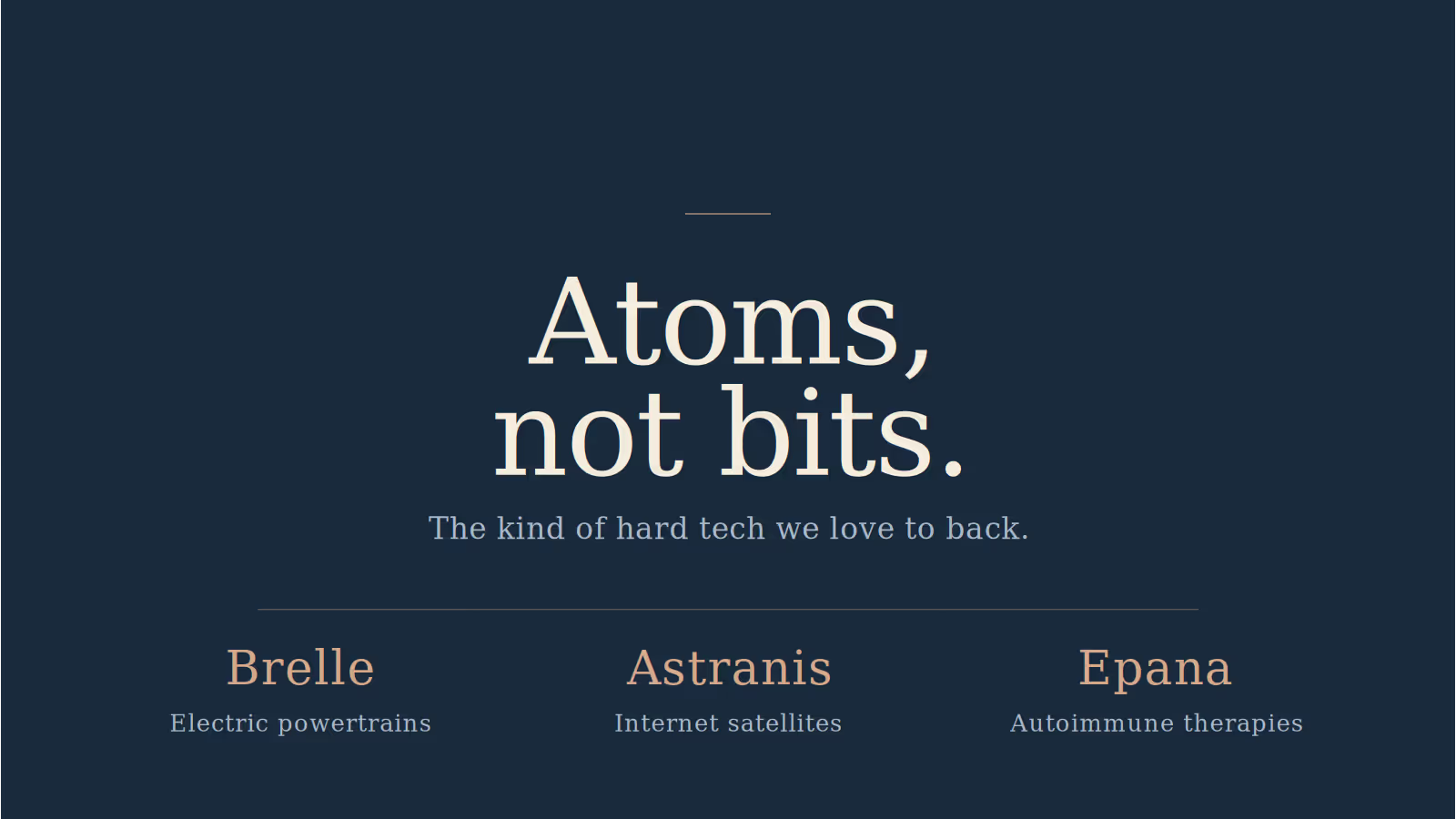
"Atoms, not bits" is shorthand for companies that build physical things — molecules, machines, materials, infrastructure — instead of products that live only on a screen. It's how I've described Refactor's investment thesis since I started the firm in 2015.
Atoms-based companies are harder to start. They take longer to build. They cost more capital. They require regulatory approval, supply chains, and pilot facilities. By every conventional measure, they look like worse venture investments than pure software.
But the moats are real. The customers are sticky. The outcomes, when they work, are generational. And the founders who choose to do this work are doing it because they believe it has to be done, not because they're chasing a trend. Those are the people I want to spend the next decade backing.
Why now is the moment
A few things are happening at once that make 2026 a remarkable time to be a hard tech investor.
First, the cost of building physical companies has come down. Reusable launch capability has cut the cost of getting things into space. Modular manufacturing and contract bio-fabs have made it possible to prototype hardware and biology faster than ever. AI is genuinely useful for designing molecules, optimizing chip layouts, and accelerating simulation cycles — not as a replacement for engineers, but as a force multiplier for them.
Second, the United States is rediscovering the importance of building things. Reindustrialization, energy independence, biosecurity, and supply chain resilience are bipartisan priorities now. Capital that used to flow only into software is finally flowing into the critical industries — aerospace, energy, nuclear, defense, advanced manufacturing, critical materials, biology — that underpin a functioning economy.
Third, and most importantly, the talent is here. The best engineers, scientists, and operators I've ever met are choosing to build physical companies. They're leaving SpaceX, Tesla, Moderna, and the national labs to start things. That's the strongest leading indicator I know of for where the next decade of returns will come from.
What this looks like in our portfolio
A few examples from the Refactor portfolio that show what "atoms, not bits" looks like in practice.
Brelle is building electric powertrains for the kind of vehicles that are still stuck on diesel — heavy-duty, off-highway, industrial. The team understands that electrifying a haul truck or a forklift is a fundamentally different engineering problem than electrifying a sedan, and they're solving it from first principles. Every Brelle powertrain that ships displaces a diesel engine that would otherwise be running for the next twenty years.
Astranis is building small geostationary internet satellites that bring broadband to the parts of the world the legacy operators have ignored. They're putting birds on orbit that connect entire regions (Alaska, the Philippines, Mexico, Peru, etc.) that haven't had real internet before. It's hardware, propulsion, RF engineering, and orbital mechanics, all done by a team that decided to vertically integrate every piece of it.
Epana is developing next-generation autoimmune therapeutics: going after diseases like lupus, rheumatoid arthritis, and inflammatory bowel disease with a fundamentally new modality. Autoimmune conditions affect tens of millions of people, and the existing therapies are blunt instruments. Epana is building precision tools instead.
Brelle, Astranis, and Epana don't have much in common on the surface. One builds powertrains, one builds satellites, one builds drugs. But all three are run by founders who decided to take on a hard physical problem because they believed the world would be better if it got solved. That's the through-line of every investment we make.
What we look for at the seed stage
When a hard tech founder shows up in my inbox, I'm looking for three things.
A team with deep, earned expertise in the physics, biology, or chemistry of the problem they're solving. Hard tech doesn't reward generalists at the seed stage — it rewards people who have spent years inside the industry they're now refactoring.
A real, defensible moat — proprietary data, a manufacturing advantage, a regulatory pathway, or a piece of hardware that's genuinely hard to copy. Software-style moats don't translate to atoms.
And most importantly, founders who are absolute magnets. Magnets for customers, talent, and investors. Their outlier ability to gather people, resources, and capital to their mission is why VCs always say they like to "Back the best founders". It may sound trite, but really, they're seeking magnets.
The most optimistic time to be backing builders
I'm an optimist about almost everything, but I'm especially optimistic about this. The founders building physical companies right now are working on the problems that actually matter — clean energy, accessible internet, better medicines, secure supply chains, the rebuilding of American industrial capacity. The capital, the talent, and the technology are all aligned in a way I haven't seen before in my career.
More things are possible right now than most people imagine. If you're a founder building something physical and you want a partner who'll show up early, write a real check, and stay close for the long haul, send me a note on the Contact page. All submissions go straight to my inbox.
.svg)


