

Therapy and coaching, on Refactor
Building a hard tech company is one of the most punishing things a person can do with their life. You're trying to bend physics, biology, or chemistry into a product, raise capital against decade-long timelines, hire engineers who could be making twice as much at a hyperscaler, and convince a skeptical world that your version of the future is the right one. And you're often doing it on five hours of sleep.
Founders pay for that ambition with their mental health. So do the engineers, scientists, commercial folks, and operators they bring along for the ride. I've watched it happen across five funds.
So, back in 2020, during COVID, I started picking up the bill. For everyone.
What we offer, in plain terms
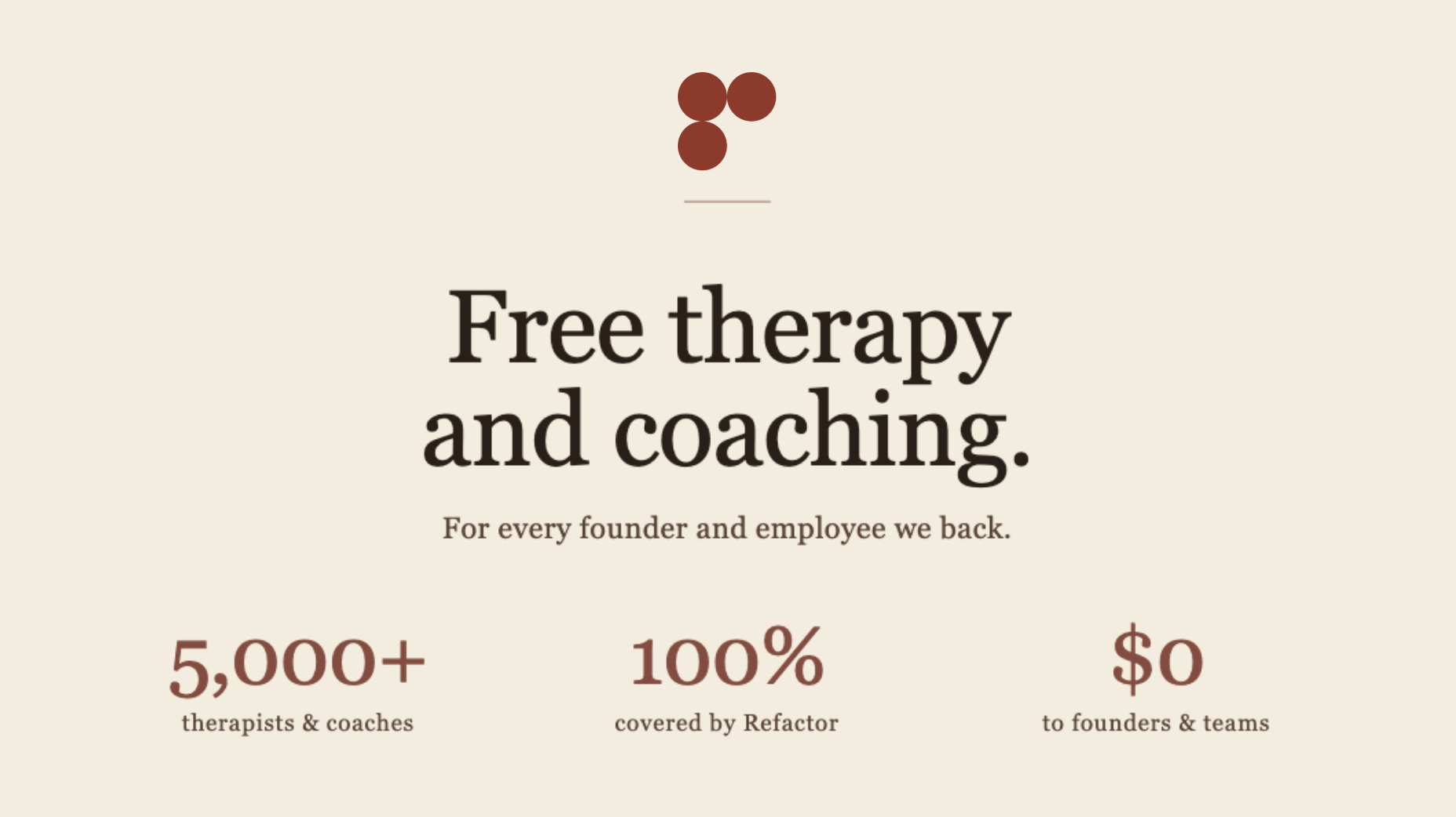
Every founder I back gets free mental health therapy and coaching. So does every single employee at every seed-stage Refactor portfolio company: engineers, scientists, operators, the whole team. No copays. No paperwork from the company. No hoops.
We do this through our partner Lyra Health, which runs an extended network of more than 5,000 licensed therapists and coaches across the US. Founders and their teams can book sessions for anxiety, burnout, founder isolation, executive coaching, relationship support, grief, addiction recovery — the full spectrum of what humans actually deal with when they're trying to build something hard.
Lyra sends me one bill a month. I pay it out of the Refactor management company. That's it. That's the whole program. Once companies graduate by raising a Series A, I typically ask CEOs to pick up that benefit for their teams.
How the privacy works
This is the part that matters most, and the part founders ask about first.
The Lyra invoice that hits my inbox every month is anonymized. It does not show me who used the service. It does not show me which portfolio company they came from. It doesn't break out sessions by individual or team. I see a number, I pay the number, I move on.
That design is intentional. The minute a founder (or one of their employees) thinks their investor might find out they're in therapy, the program is dead. So I built it so I literally can't find out, even if I wanted to. I'm not the gatekeeper. I'm the check writer.
Why a seed fund covers this instead of waiting for the company to
Most seed-stage hard tech companies — frontier tech, deep tech, the kind of work happening in critical industries like aerospace, biotech, energy, nuclear, defense, advanced manufacturing, and critical materials — don't have HR for the first few years. They have a founding team and a runway. Health benefits get bolted on later, usually around the Series A, and mental health coverage is almost always the last thing added.
That timing is exactly backwards. The hardest psychological stretch of building a company is the first two years, when the team is small, the science is unproven, and the world hasn't caught on yet. The first ten employees of a hard tech company are taking the same existential risk the founders are; sometimes more, because they don't have the founder's equity story to comfort them. Waiting until the Series A to give that team access to a therapist is like waiting until you've crossed the desert to hand out water.
So Refactor covers it from day one. For the founders, and for everyone they hire. It is not charged back to portfolio companies. It does not affect a company's burn. It doesn't show up in a board deck. It is, for the founders and their teams, free.
Why I think every fund should do this
The math on this is genuinely not hard. Lyra's pricing for a portfolio of our size is a rounding error against what we deploy in capital each year. The downside of not having it — a founder spiraling alone, a key engineer quietly burning out, a CEO who doesn't realize they need help until they've already made the irreversible decision — is a fund-returner-killing risk that nobody puts on a risk register.
Also, it's a great way for founders and employees to test out having a professional coach on my dime.
The job of a seed-stage venture investor is to give portfolio teams every unfair advantage I can. Capital is the obvious one. But access to a therapist who's seen a hundred other founders and operators go through exactly what you're going through right now, on a Tuesday at 9pm when you can't sleep — that's the kind of edge that doesn't show up on a pitch deck.
The hard tech Refactor backs will take a decade or more to build. The least I can do is make sure the people building it stay healthy, perform at their peak, and can sleep at night, well at least on the nights they actually want to. 🙂
#BetterCallZal
.svg)


